How to Run a Clipping Campaign
Running a clipping campaign means setting a brief, finding clippers you trust, reviewing what they post and paying on verified views. Here is what each stage involves and where campaigns usually go wrong.

A clipping campaign looks simple from outside: supply footage, pay for views. The work is in the parts nobody sees, from the brief that decides whether clips are usable to the verification that decides what you pay for. This guide walks through how a campaign is actually run.
What a clipping campaign is buying
A clipping campaign pays independent editors to cut your long form content into short clips and post them on their own accounts, with payment tied to verified views rather than to posts made.
That last part is what makes it different from most media. You are not buying impressions at a fixed price and watching them stop when the budget does. Clips keep accumulating views after a campaign closes, at no further cost, and they arrive in the feed looking like content rather than advertising. Why your brand should do clipping covers the case for it; this guide is about the mechanics.
The five stages
How a campaign actually runs
Decide what the campaign is for
Reach, app installs, a launch moment, or a back catalog nobody is finding. These need different clip strategies and completely different measurement, and "going viral" is not an objective.
The decision made here constrains everything after it, including which source footage is worth supplying and what counts as a result.Write the brief
The brief is the campaign. It sets the rate per thousand verified views, the minimum views a clip must reach to be paid, how long views are counted for, which platforms count, and the content rules: hooks, required tags, what is off limits and how the brand may be shown.
Ambiguity here surfaces later as clips you cannot use and arguments you cannot win, because the clipper followed what was written.Find and vet the clippers
Anyone can post a clip. The work is in knowing whose audience is real, who delivers consistently, and who understands a brief without being chased.
Vetting means checking genuine engagement rather than follower counts, and verifying that a clipper's viewers are real people in the markets the campaign is aimed at. An open call skips this and the cost shows up in the approvals queue.Review what comes in
Every clip is checked before it is approved: brand safety, accuracy, whether it follows the brief and whether it meets platform rules.
This is the stage that protects you. Clips of your content will sit next to whatever else is in the feed, and clippers will frame things in ways nobody at your company wrote. Somebody has to be accountable for that, in writing, before the campaign opens.Verify views and pay out
Views are counted through platform data over the campaign's window, approved clips are settled against the budget, and clippers are paid on what was verified rather than what was claimed.
Clean payout records matter more than they sound. They are what lets you report honestly on cost per thousand views at the end.
Where campaigns go wrong
The four most common failures
Source material that does not clip
Long form, conversational, opinionated content produces clips. Polished brand video usually does not, because there is no moment inside it that stands alone. If there is no suitable footage, the first job is making some, not hiring clippers.
Measurement agreed after launch
Views are easy to count and easy to overvalue. Decide what counts as a result and how it is attributed while it is still a conversation rather than an argument, and judge the campaign on the measure you set rather than the one that looks best afterwards.
Nobody accountable for brand safety
A campaign with no named reviewer is a campaign where the first problem is discovered by someone outside the company. Agree what is acceptable in writing and have a person checking against it.
Treating volume as the strategy
Output is not what produces the views. Watch through in the first two seconds is, and a campaign of 15 strong clips will beat 50 weak ones on identical footage. Paying per view rather than per post aligns that, as long as the brief is good enough to get strong clips made.
Running it in house or bringing someone in
In house
Full control, and it costs management time. Somebody has to write the brief, recruit and vet clippers, review every submission, chase the ones that miss the brief, verify views and run payouts, continuously, for as long as the campaign is open.
With an agency
An existing roster of vetted clippers, a brief written by people who have written a hundred, review and payouts handled, and reporting you can take to a board. You give up some direct control over who is posting in exchange for not building the operation.
The honest test
Whether anyone at your company has the hours to run it properly. A half run campaign is worse than none, because the clips still carry your brand whether or not somebody was checking them.
Why brands run them with us
Clipping Hall of Fame is run by Fixated, an award winning talent management and media agency, and clipping campaigns are not something we added recently. The roster is vetted, the briefs are written by people who write them every week, and reporting is tracked rather than estimated.
There is one structural difference worth knowing about when you are comparing options. Most clipping services pick up at distribution: the content exists, and they get it clipped. Because the agency around us handles talent, ideation and production as well, a campaign can start earlier than that. If the footage that would clip well does not exist yet, we can make it, which means the campaign is not capped by what happens to be in your archive.
There is also reach behind the campaign before a single clipper posts. We operate our own portfolio of high reach social accounts, the O&O network, doing more than 2 billion monthly impressions and 500 million monthly engagements across more than 500 partners. A campaign can start from that rather than from zero.
What our campaigns have delivered
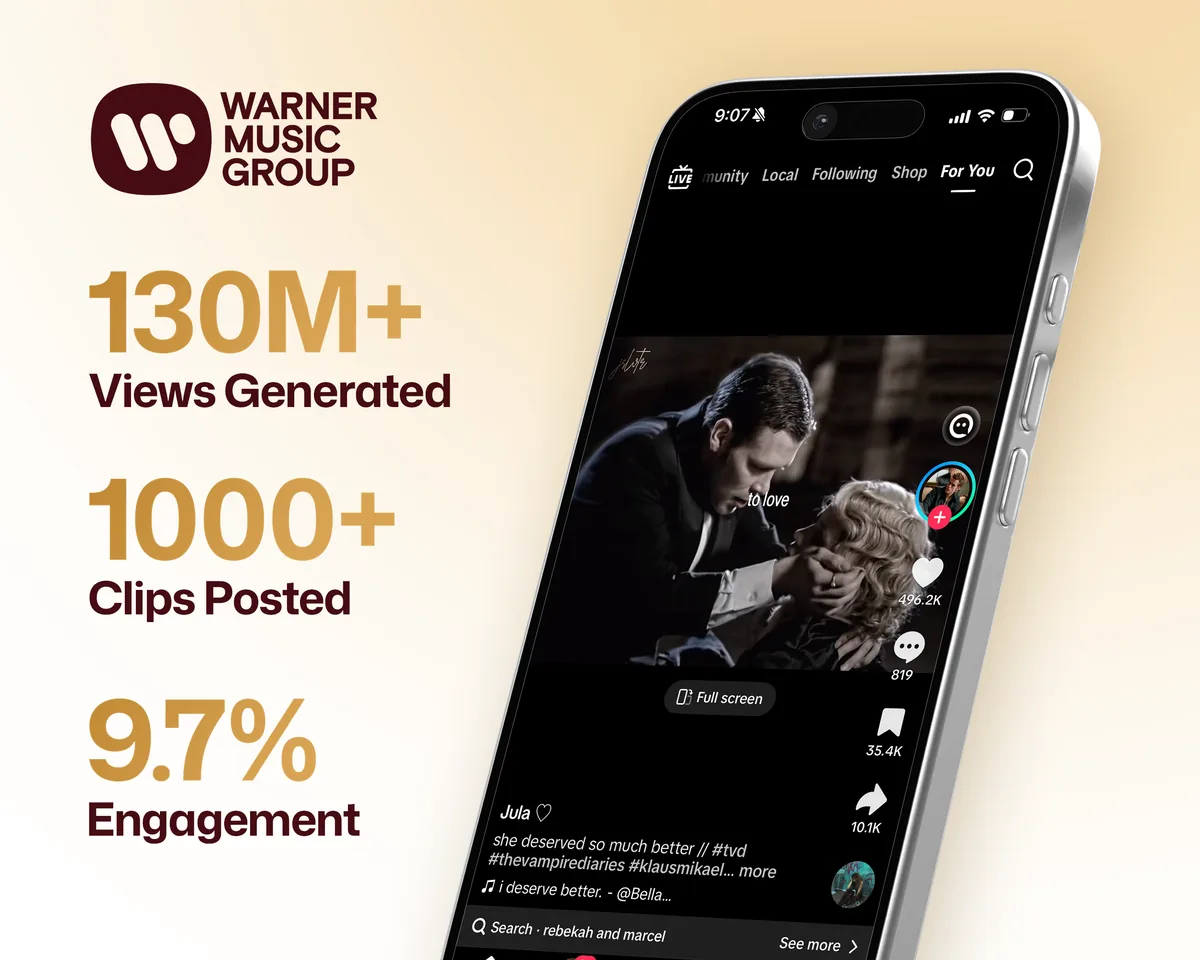
Real briefs and real numbers rather than projections. Each one sets out what the client wanted, what was made, and what it returned.
FAQs
Campaigns are normally funded as a budget paid out per thousand verified views, so the cost scales with the result rather than being fixed in advance. What moves the rate is how commercially valuable the audience is and how tightly the campaign is vetted, and the total is capped by the budget you set.
A campaign can be briefed and open within days once the source footage and the rules are settled. Clips keep accumulating views after the campaign closes, so the reporting window usually runs beyond the posting window.
Long form, conversational and opinionated material, such as podcasts, streams and interviews, because it contains moments that stand alone. Highly produced brand video tends to clip badly, since nothing inside it works out of context.
With a written brief that states what is off limits and how the brand may be shown, a vetted roster rather than an open call, and a named reviewer checking every clip before it is approved. Clips sit next to whatever else is in the feed, so this has to be decided before a campaign opens rather than after.
Through platform data over a defined counting window, against the accounts the clipper registered. Payment is made on verified views only, which is what makes the reporting at the end of a campaign something you can stand behind.
Usually performance based, paid per thousand verified views against a budget you set, so spend follows results. Flat fee arrangements make sense where the deliverable is the content itself rather than the reach, for example a fixed set of clips produced to a schedule, and plenty of campaigns combine the two.
The honest answer is that nobody can guarantee a view count, and anyone who does is guessing. What can be committed to is structure: a budget that is only drawn down against verified views, a vetted roster rather than an open call, every clip reviewed before it is approved, and reporting you can audit. Paying on verified views is itself the protection, because unverified reach costs you nothing.
Source footage worth clipping, a clear objective, and someone empowered to sign off the content rules. If the footage does not exist yet that is solvable, since production can be part of the campaign, but the objective and the sign off cannot be worked out afterwards.