Why Should Your Brand Do Clipping?
Clipping puts your content in the one format the feed is built to reward, and keeps distributing it after the budget stops. Here is the case for it, what it looks like for four different kinds of brand, and what our campaigns have returned.

Clipping has gone from something creators did for themselves to a line in serious media budgets, and the reason is simple: an engaged clip keeps being distributed for free, long after a paid placement would have stopped. This is the case for it, and what it looks like in practice.
The mechanism, in one paragraph
A clip does not just put your content in front of people. It puts it in front of them in the format the feed is built to reward, and every watch, share and comment tells the platform to show it to somebody else. Paid media stops the moment the budget does. An engaged clip keeps being distributed, free, by the algorithm, because people are responding to it. That is the whole argument, and everything below is a consequence of it.
What the engagement buys you
Five things a clipping campaign returns
Reach that keeps compounding
A clip that holds attention gets pushed further, and the clips that land keep accumulating views for weeks after they were posted at no extra cost. One campaign can still be delivering impressions long after the invoice is settled, which is something a paid placement cannot do.
Moments amplified while they still matter
A launch, a drop, an announcement or an appearance has a short window where attention is already pointed at you. Dozens of clips posted into that window turn a single moment into a week of coverage, and that timing is difficult to buy any other way.
A back catalog that starts working again
Most brands are sitting on hours of podcasts, streams, interviews and long form video almost nobody has seen. Clipping turns that archive into hundreds of pieces of short form without filming anything new, which is usually the cheapest reach available to you.
Placement that reads as content
A clip arrives in the feed looking like the rest of the feed. People watch it because it is interesting rather than tolerating it because it is an ad, and that difference shows up in watch through, in comments, and in how much of the message actually lands.
Signal you can act on
A campaign of 300 clips is 300 tests of what your audience responds to. Which hooks hold, which topics travel and which formats stall is useful well beyond the campaign, and it feeds straight into what you make next.
Paid media buys attention for as long as you pay for it. A clip that earns attention keeps being distributed after you stop.
What it looks like for four kinds of brand
The shape of a campaign changes a lot with what you have and what you want. These are illustrative rather than drawn from specific clients.
Four worked shapes
A consumer brand with a launch
The problem: a product drop with a two week attention window and no owned audience big enough to fill it.
The shape: a short, dense campaign timed to the drop, across TikTok, Reels and Shorts, paying per verified view so spend follows performance. The goal is coverage density inside the window rather than total clips.A video game studio
The problem: hours of trailers, dev diaries and streamed gameplay, and reach that stops at people who already follow the game.
The shape: clips built from the moments that read without context, a kill, a reveal, a reaction, pushed to audiences who have never heard of the title. Games clip unusually well because the footage is already visual and already dramatic.A podcaster
The problem: a back catalog of hundreds of hours that new listeners will never find, and growth that depends entirely on recommendation.
The shape: the single most natural fit for clipping. Conversational long form is full of standalone moments, and one clip of a strong exchange can bring an audience to an episode recorded two years ago. Our guide to clipping podcasts covers the craft.A streamer
The problem: a stream is gone when it ends, and the best 30 seconds of an eight hour broadcast are seen only by whoever was watching live.
The shape: continuous rather than campaign shaped, with clips cut from every broadcast and posted to audiences off the streaming platform entirely. See clipping on Twitch and Kick.
What our campaigns have returned
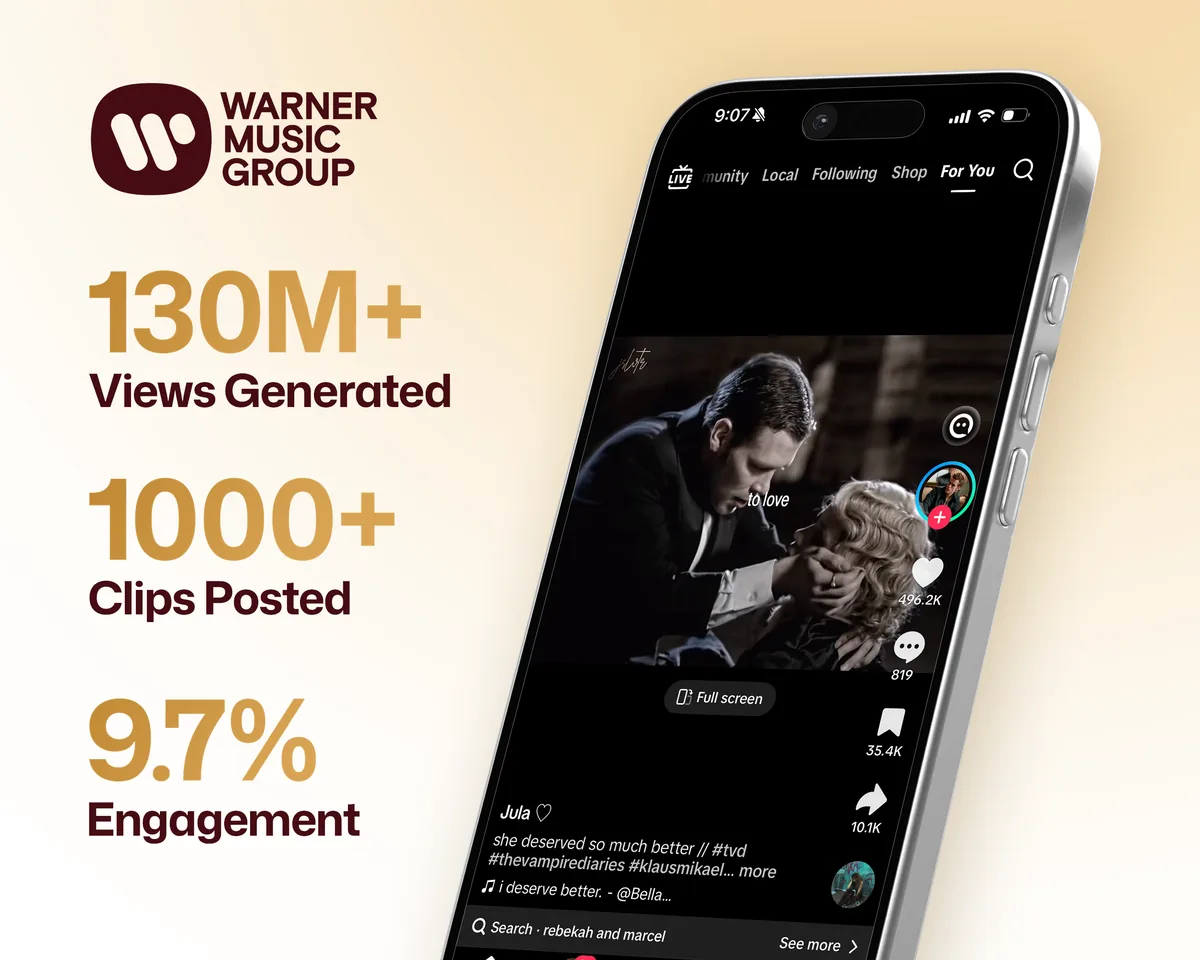
Results from real campaigns
Each of these sets out what the client wanted, what was made and what it delivered. Real briefs and real numbers rather than projections.
What makes the difference between campaigns
Output is the part people fixate on, and it is not the part that pays.
Three things that decide whether a campaign works
Engagement buys the impressions, not volume
View counts are not a function of how many clips get uploaded. They are a function of how many people watch past the first two seconds and react. A campaign of 15 clips with strong hooks will beat one of 50 with weak ones on identical footage, often by an order of magnitude.
Source material decides the ceiling
Long form, conversational and opinionated content produces clips. Highly produced brand video usually does not, because no moment inside it stands alone. That decision is made before anyone opens an editor, and it constrains everything after.
Who runs it is not a detail
Clips of your content sit next to whatever else is in the feed, and clippers will frame things in ways nobody at your company wrote. Brand safety, a clear brief and honest measurement are what separate a campaign that builds something from one that just produces view counts.
Why run it with us
Clipping Hall of Fame is run by Fixated, an award winning talent management and media agency, and the campaigns we run come from a client network built over years rather than an open marketplace.
The difference worth understanding is where we start. Most clipping services begin once the content already exists: you hand over footage and they distribute it. We can supply the talent, build the idea and produce the content as well as clip it, because the agency around us already does all three. That means a campaign is not limited to whatever happens to be in your archive. We can make the moment and then distribute it, rather than only the second half.
There is also reach behind a campaign before a clipper posts anything. We operate our own portfolio of high reach social accounts, the O&O network, delivering more than 2 billion monthly impressions and 500 million monthly engagements across more than 500 partners. A campaign can begin from that rather than from a standing start, which is the part that is genuinely hard to replicate in house.
Brands we have worked with
Campaigns run through the network behind Clipping Hall of Fame. See the results on our homepage.
 EA
EA Gopuff
 DoorDash
 PrizePicks
 Logitech
 Kalshi
 Amazon Music
 BuzzFeed
 Genesis
 Hyundai
 Activision
 Live Nation
 Warner Music
 Ubisoft
 Uber Eats
 Stake
Stake Unrivaled Basketball
 America's Test Kitchen
 ProBox TV
FAQs
It works when the source material contains moments that stand alone and the campaign is briefed and reviewed properly. The mechanism is real: an engaged clip earns further distribution from the platform at no extra cost, which is why reach keeps compounding after the spend stops.
Anyone sitting on long form content that almost nobody has seen, and anyone with a moment worth amplifying inside a short window. Podcasts, games, streams and interview led content clip best, because they contain standalone moments.
It is priced differently. Paid social buys impressions at a fixed rate and stops when the budget does, while clipping pays per verified view and the clips keep delivering afterwards. The honest comparison is cost per thousand views measured after the campaign, not the headline rate.
On verified views counted through platform data over a defined window, reported against the budget. Agreeing what counts as a result before launch matters, because views are easy to count and easy to overvalue.
A written brief stating what is off limits and how the brand may be shown, a vetted roster rather than an open call, and a named reviewer approving every clip before it goes up. That has to be settled before a campaign opens.
Because short form feeds stopped rewarding follower count and started rewarding watch through, which means a clip from an account nobody follows can outreach a brand's own channel. That change turned distribution into something you can buy per result rather than per post, and it is why budgets that used to go entirely to paid social now carry a clipping line.
It does while your competitors are still treating short form as an afterthought, and the advantage is in the archive rather than the ads. A brand sitting on hours of unwatched long form can turn it into hundreds of pieces of short form without filming anything, and a competitor without that content cannot match it by spending more.
Games clip unusually well, because the footage is already visual and already dramatic. Trailers, dev diaries and streamed gameplay contain moments that read without any context, which is exactly what travels, and clipping puts those in front of people who have never heard of the title rather than only the players already following it.
Campaigns are normally performance based, paid per thousand verified views, so spend follows results rather than projections. Flat fee work exists for pieces where the output rather than the reach is the deliverable, such as a fixed set of clips produced to a schedule, and the right structure depends on whether you are buying reach or buying content.